Animals Are Forcibly Taken To Slaughterhouses Against Their Will And Killed. A slaughterhouse is where…
Thousands Of African Penguins Starve To Death.
More than 60,000 penguins in colonies off the coast of South Africa have starved to death as a result of disappearing sardines, a new paper has found.
More than 95% of the African penguins in two of the most important breeding colonies, on Dassen Island and Robben Island, died between 2004 and 2012.
The breeding penguins probably starved to death during the moulting period, according to the paper, which said the climate crisis and overfishing were driving declines.
The losses that researchers recorded in those colonies were not isolated, said the paper, which was published in Ostrich: Journal of African Ornithology.
“These declines are mirrored elsewhere,” said Dr Richard Sherley, from the Centre for Ecology and Conservation at the University of Exeter.
The African penguin species has undergone a population decline of nearly 80% in 30 years.
African penguins shed and replace their worn-out feathers every year to protect their insulation and waterproofing.
However, during the moulting period, which takes about 21 days, they have to stay on land.
To survive this fasting period, they need to fatten up beforehand.
“If food is too hard to find before they moult or immediately afterwards, they will have insufficient reserves to survive the fast,” said Sherley.
“We don’t find large rafts of carcasses, our sense is that they probably die at sea,” he said.
( Phoebe Weston, 05.12.2025 ) .. theguardian.com
Nearly 3,000 Species In Wales Are At Risk Of Extinction.
Nearly 3,000 species in Wales, UK, are now found in just a handful of locations, according to a report.
These species include hundreds of plants, fungi and mosses, as well as 25 bird, six mammal, five freshwater fish and one amphibian species.
The report, produced by Natural Resources Wales (NRW), a Welsh government-sponsored body, notes that 114 species were last seen in Wales in the 1950s or later.
Since 2000, eleven of these species have gone locally extinct, including the whiteworm lichen, belted beauty moth, and birds like the corn bunting and European turtle dove.
“This report makes it clear that we aren’t simply ‘at risk’ of seeing species going extinct in Wales, it’s already happening”, Mary Lewis, head of natural resource management policy at NRW, said in a statement.
Not all the 3,000 species are necessarily declining.
Nearly half may appear spatially restricted because they’re under-recorded, the report notes.
Agriculture and climate change are systemic pressures on Welsh biodiversity, the report finds.
But more local threats that drive wildlife population declines include the loss of deadwood in woodland, tree planting in grasslands, changes to peatlands, pollution in ponds and lakes, and changes to coastal and riverine habitats.
( Mongabay, 03.12.2025 ) .. mongabay.com
Endangered Wildlife Animals Are Being Advertised For Sale As Food On TikTok.
Critically endangered animals are being advertised for sale as bushmeat on TikTok, a new study finds.
Bushmeat is meat sourced from wild animals, and is commonly eaten in many African and some Asian countries.
Though some people hunt for personal consumption, many hunters sell meat to regional traders, who may then sell it to families or restaurants.
The new study builds on older research linking social media to the wildlife trade.
A 2023 study, for example, showed how Facebook was used by the bushmeat trade in West Africa.
Now TikTok is on the rise in Africa, which led an international team of researchers to examine its potential role in the illegal wildlife trade in Lomé, Togo.
The researchers assessed 80 videos from two public TikTok accounts, recording an estimated 27 species and 3,526 individual animals, including endangered pangolins and a vulnerable antelope species.
The accounts were mainly used to advertise meat for sale at physical markets in Lomé rather than directly through TikTok, says the nonprofit World Animal Protection’s head of research, Angie Elwin, a co-author of the study.
( Sam Meadows, 11.12.2025 ) .. scientificamerican.com
Shamefully, Ireland Is Now The Puppy Farm Capital Of Europe And Has A Major Animal Cruelty Problem.
While the public demands change, Ireland’s weak laws, poor enforcement and Government inaction are allowing puppy farms, blood sports and racing abuses to flourish.
Ireland is in the grip of an animal cruelty epidemic.
Significant gaps in legislation and lack of enforcement are fuelling the crisis, with no real will at Government level to tackle the issue and animal welfare charities and shelters left to pick up the pieces.
This political inertia is completely at odds with the public’s desire for action.
In Ireland, there is no formal licensing system for sulky racing.
Sulky racing involves high-speed horse-and-cart racing, frequently occurring on public roads, motorways, and in housing estates.
While unlicensed racing is illegal on public roads, Garda enforcement often falls short, as it can prove difficult to identify the organisers.
Horses, by law, are supposed to be microchipped and have passports.
However, this is another area where enforcement is weak.
Ireland is facing a dog welfare crisis, with more than 3,000 stuck in pounds and rescue centres around the country.
Abandonments have surged since Covid 19, with the cost-of-living and housing crises adding to the problem.
In 2022, 7,352 dogs entered Irish pounds, a 77% increase on 2021, and 340 were euthanised.
In 2024, these shocking figures remained largely unchanged.
Shamefully, Ireland is now the puppy farm capital of Europe, with estimates that 30,000 dogs are exported annually into illegal markets in the UK, Europe and Asia.
This estimate, cited by the DSPCA, increases by 70,000 if you take backyard breeders into account, where hundreds of female dogs are often kept in atrocious conditions.
This scandalous situation has arisen because of weak regulation under the Dog Breeding Establishments Act 2010.
It means females as young as four months can be bred, with no maximum age, and they can have up to six litters in their lifetimes.
Ireland is one of only three EU countries where hare coursing is still legal.
There is only a 9% support for hare coursing in Ireland.
Despite this, each year the National Parks and Wildlife Service issues licences for hare netting, tagging and release for coursing, with no Government plans to ban it.
Up to 6,000 hares are captured for coursing each year, with many killed or injured during events.
Last year, the Social Democrats supported a bill brought forward by Ruth Coppinger TD to remove the exemption in the Animal Health and Welfare Act 2013 that allows for fox hunting with dogs.
This barbaric activity is now only legal in a small number of countries and has been banned in the UK for 20 years.
Despite the nonsensical argument often put forward that fox hunting is an important part of rural Ireland tradition, the public thinks otherwise.
73% supported an outright ban on hunting with dogs.
However, Ireland continues to be an outlier when it comes to fox hunting after Government-supporting TDs and Sinn Féin voted down Deputy Coppinger’s bill.
It was a wasted opportunity to consign this archaic blood sport to history once and for all.
( Jennifer Whitmore, 18.02.2026 ) .. thejournal.ie
The Conviction Is The Second Time These Bloodthirsty Arseholes Have Been Caught Out Illegally Hare-Hunting.
Hunt Saboteurs Association (HSA) is celebrating the legal victory, with another huntsman brought to justice.
Northampton magistrate’s court has found Philip Saunders guilty of illegal hunting.
Saunders is one of the arsehole huntsman for criminal gang, the Pipewell Foot Beagles.
The conviction is the second time these bloodthirsty arseholes have been caught out illegally hare-hunting.
The court heard how Saunders led his pack to kill a hare at the Boughton Estates on Kettering.
Richard Scott is the current Duke of Buccleuch and one of the largest land owners in Scotland.
It’s no shock that he would allow an illegal hunt to take place on ‘home turf.
Courageous wildlife photographer Emma Reed was on the scene and captured the entire incident.
Reed’s video clearly shows Saunders encouraging the hounds to kill.
The huntsman was heard growling “Get onto it!” at the dogs.
This is a specific hunting term which incites animal cruelty and it proves the hunt intended to pursue the hare.
As per usual, the HSA provided names to the police at the time, but they failed to act on the evidence. Again.
The magistrate fined Saunders £1,000 for his role in the illegal hunt.
He also has to pay £3,600 in costs and a £400 victim surcharge.
In the landmark move, the court also ordered the destruction of Saunders’ hunting horn.
Saunders must surrender it to the police.
Destroying the horn is beautifully symbolic as this is the primary tool a huntsman uses to control the hounds.
The HSA believe this should be common practice in all cases as it effectively strips the bloodthirsty wankers of the ability to lead.
( Antifabot, 19.02.2026 ) .. thecanary.co
Shocking Conditions Revealed At UK Pig Farm.
New undercover footage from a Herefordshire pig-rearing site has raised questions about welfare standards and the meaning of high-welfare labels in the UK pig sector.
The material, filmed in November 2025 at Bage Court Farm in Dorstone and collected by Animal Justice Project (AJP), shows pigs kept indoors in crowded pens with minimal enrichment, including animals with visible injuries and mobility problems.
AJP says the footage is inconsistent with the “outdoor bred” label and the RSPCA Assured certification under which the farm operates.
Bage Court Farm rears pigs under contract to Stockcroft Ltd, one of Britain’s largest “outdoor bred” suppliers.
The company works with more than 80 farms and supplies major retailers and foodservice firms, including Co-Op, Marks & Spencer and McDonald’s.
( The Havering Daily, 19.02.2026 ) .. thehaveringdaily.co.uk
Sea Turtles Are Freezing Due To Climate Change.
Along the beaches of Cape Cod, volunteers are braving freezing winds to search for stranded sea turtles and other vulnerable animals that can no longer swim.
Drawn north by warming seas, these young turtles become trapped when temperatures suddenly drop, leaving them cold, stunned and close to death.
Each winter, hundreds of juvenile turtles wash ashore along Cape Cod Bay, unable to escape as the water falls below survivable levels.
Disoriented and barely moving, the animals often blend into seaweed and sand, making rescue a race against time.
According to Teresa Tomassoni of Inside Climate News, this is now the largest cold stunning event affecting sea turtles anywhere in the world.
Scientists link the surge in strandings to rapid ocean warming driven by Climate change.
The Gulf of Maine is heating faster than almost any other marine region on Earth, creating a dangerous ecosystem.
Warmer conditions lure turtles north to feed, but geography and sudden cold snaps block their return south.
Dedicated volunteers and rehabilitation teams are stepping in to protect wildlife along these coasts.
Rescued turtles are slowly warmed, treated for infections, and cared for over months before release.
( Supertrooper, 20.02.2026 ) .. focusingonwildlife.com
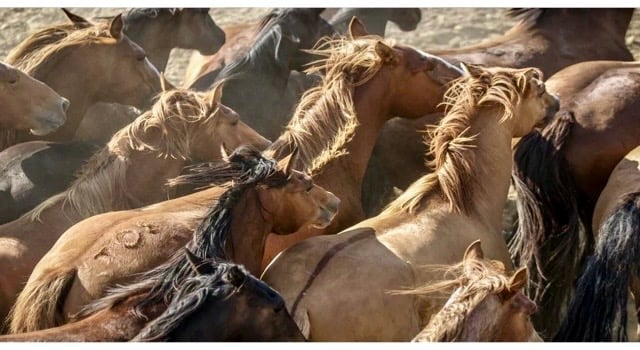
American Wild Horses And Former Race Horses Are Sold To Slaughterhouses In Canada And Mexico.
At a feedlot in Alberta, Canada, up to 10,000 horses await their death.
In the winter, when temperatures can drop to minus 30 deg. F, the snow-covered horses huddle together for warmth.
On multiple occasions, only a handful of employees were around to check on the animals, and scavengers have picked over neglected carcasses.
In 2019, a dead newborn foal was found frozen to the ground.
About 20,000 U.S. horses, including former racehorses, work horses, show animals, discarded pets, and even wild horses, are sold to slaughterhouses in Canada and Mexico every year.
While there’s no explicit ban on killing horses for meat in the U.S., Congress has blocked funding of USDA inspections of horse slaughterhouses since 2007.
Without these inspections, it’s illegal to sell horse meat across state lines.
No such bans exist in neighbouring countries, which is why Canada and Mexico have become a “dumping ground” for unwanted horses.
In 2022, more than 16,300 U.S. horses were shipped to Mexico and more than 5,100 to Canada, according to USDA export data.
The supply of U.S. horses to the foreign meat industry has sharply declined from more than 300,000 in the 1990s.
But the auction-to-slaughter pipeline remains notorious for its suffering.
Investigations of auctions, holding pens, transport, and slaughterhouses have found animals injured, diseased, and starving, according to the report, compiled by the three animal-welfare nonprofits.
Witnesses saw downed animals dragged from trailers, beaten by their handlers, and trampled by other horses.
There’s no official system for tracking the origin of these animals, but more than half of those going to slaughter originate from horse racing or show industries.
( Rachel Fobar, 10.03.2023 ) .. nationalgeographic.com
Tens of thousands of American horses, including former racehorses and captured wild horses, are transported annually to Canada and Mexico for slaughter to satisfy foreign demand for horse meat.
While the slaughter of horses for human consumption is effectively banned within the United States due to a lack of federal funding for inspectors, no law prohibits the export of live horses for this purpose.
In 2025, more than 24,000 American horses were shipped to slaughterhouses in Canada and Mexico, representing a roughly 21% to 24% increase from 2024.
Canada primarily exports the resulting meat to Europe, while Mexico uses some meat domestically and exports the rest.
Horses endure long, gruelling journeys in overcrowded trailers, frequently without food, water, or rest. Investigations have shown that horses often arrive with severe injuries, with some dying during transport.
An estimated 50% or more of horses sent to slaughter originate from the racing or show industries.
Many of these horses are retired, injured, or simply no longer profitable, often identified by lip tattoos.
Despite being protected by federal law, an unknown number of wild horses and burros captured by the Bureau of Land Management (BLM) end up in the slaughter pipeline.
( Rose Winfold, 14.02.2026 )
Related Posts

Comments (0)