The BBC Is Writing Hundreds Of Articles On Iran’s Alleged Nuclear Programme While Failing To…
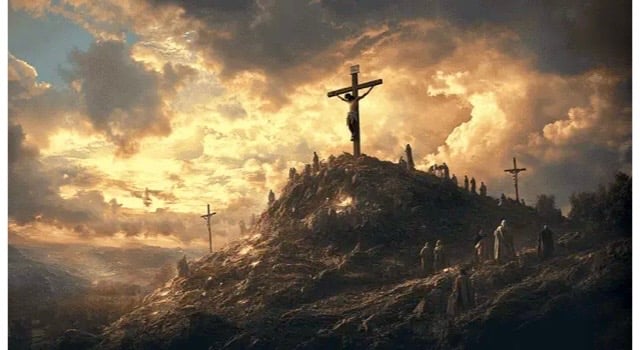
The Crucifixion and The Resurrection of Jesus Christ.
The crucifixion and resurrection of Jesus Christ stand at the heart of Christian belief.
For billions of people, these events represent sacrifice, redemption, and hope.
At the same time, historians and scholars continue to examine them through historical and textual analysis.
A Note on the Name “Jesus”.
An interesting historical detail often overlooked is that the letter “J” did not exist in the alphabet at the time Jesus lived.
In fact, the letter developed much later, roughly 1,500 years after these events.
During the 1st century in Judea:
- Jesus would not have been called “Jesus” in his own language.
- His name in Aramaic was likely Yeshua (ישוע).
- In Hebrew, a closely related form is Yehoshua.
- In Greek texts of the New Testament, his name appears as Iēsous (Ἰησοῦς).
- The English “Jesus” is a later development, influenced by Latin and evolving European languages.
This linguistic evolution helps explain why names and titles in the Bible can appear different from their original forms.
Why Was He Crucified?
Jesus was crucified in the 1st century CE, during Roman rule over Judea.
The reasons for his execution can be understood from both religious and political perspectives.
Religious tensions:
Jesus’ teachings challenged some established religious authorities of the time.
He criticised certain practices and claimed a unique relationship with God, which some leaders viewed as blasphemous.
Political concerns:
In a Roman-occupied region, any figure gaining a large following could be seen as a potential threat.
A key issue was the title attributed to him: “King of the Jews.”
The Title “King of the Jews”.
The title “King of the Jews” played a significant role in the events leading to the crucifixion.
- In Latin, it was written as INRI (Iesus Nazarenus, Rex Iudaeorum).
- In Greek, it would have appeared as Iēsous ho Nazōraios basileus tōn Ioudaiōn.
- In a Hebrew or Aramaic context, it would reflect something like “Yeshua of Nazareth, King of the Jews.”
According to the Gospel accounts, this title was placed on the cross by order of the Roman governor Pontius Pilate.
From a Roman perspective, calling someone a “king” could imply rebellion against Caesar, which made it a political charge rather than purely a religious one.
Who Ordered His Death?
The process involved both local religious leaders and Roman officials:
- Jewish religious authorities (such as members of the Sanhedrin) are described in the Gospels as accusing Jesus and bringing charges against him.
- Pontius Pilate, the Roman governor, ultimately ordered the crucifixion.
Crucifixion was a Roman method of execution typically used for rebels and criminals.
The Gospel accounts suggest a complex situation, with pressure from local leaders and the Roman authority making the final decision.
What Did He Say on the Cross?
The New Testament records several statements attributed to Jesus during his crucifixion.
These are often referred to as the “Seven Last Words,” though they are collected across multiple Gospel accounts:
- “Father, forgive them, for they do not know what they are doing.”
- “Truly I tell you, today you will be with me in paradise.”
- “Woman, here is your son. Here is your mother.”
- “My God, my God, why have you forsaken me?”
- “I am thirsty.”
- “It is finished.”
- “Father, into your hands I commit my spirit.”
These sayings are central to Christian reflection, expressing themes of forgiveness, suffering, and trust in God.
The Resurrection in Modern Biblical Accounts.
The resurrection refers to the belief that Jesus rose from the dead on the third day after his crucifixion.
In modern Bibles (based on ancient manuscripts), the general outline is:
- Jesus is buried in a tomb.
- On the third day, the tomb is found empty by women followers.
- Jesus appears to his disciples and others over a period of time.
- These appearances are described as physical yet transformed encounters.
Christian leaders and theologians interpret the resurrection as proof of Jesus’ divine nature and victory over death.
It is celebrated annually at Easter and is considered the foundation of Christian faith.
What Do Scholars Say About the Evidence?
The Crucifixion:
There is broad agreement among historians that Jesus was crucified.
This event is mentioned not only in Christian texts but also in some non-Christian sources from antiquity.
Because crucifixion was a common Roman practice and the accounts are early and consistent, most scholars accept it as a historical event.
The Resurrection:
The resurrection is more debated.
Believers’ perspective:
- The empty tomb.
- Reports of appearances.
- The rapid growth of early Christianity.
These are seen as supporting evidence that something extraordinary occurred.
Skeptical or historical perspective:
- The accounts come primarily from religious texts written decades later.
- There are differences between the Gospel narratives.
- Alternative explanations are proposed, such as visionary experiences or symbolic storytelling.
About Early Biblical Texts.
It is sometimes claimed that the resurrection was absent from the earliest Bible compilations and added later.
This idea requires careful clarification:
- The resurrection is already described in some of the earliest Christian writings, including letters attributed to Paul (written around 20–30 years after Jesus’ death).
- The four Gospels, written later in the 1st century, also include resurrection accounts, though with variations.
- However, certain manuscript differences do exist, for example, some of the earliest versions of the Gospel of Mark appear to end without detailed resurrection appearances, while later manuscripts include them.
So rather than being entirely absent, the resurrection tradition appears early but develops and is recorded in different ways over time.
Brief Comparisons Between the Gospel Accounts.
The four Gospels, Matthew, Mark, Luke, and John, tell the story of Jesus’ crucifixion and resurrection with many similarities, but also some notable differences.
These variations are often discussed by scholars and theologians.
The Crucifixion Accounts.
Similarities:
- Jesus is arrested, tried, and crucified under the authority of Pontius Pilate.
- He is mocked, suffers, and is executed by crucifixion.
- A sign identifying him as “King of the Jews” is placed on the cross.
Differences:
- Timing and details: The Gospel of John presents a slightly different timeline for the crucifixion compared to the others.
- Words spoken: Each Gospel records different sayings from Jesus on the cross.
For example, “My God, my God, why have you forsaken me?” appears in Matthew and Mark, while “It is finished” appears in John. - Surrounding events: Some Gospels describe additional events, such as darkness over the land or the temple curtain tearing.
The Resurrection Accounts.
Similarities:
- The tomb is found empty on the third day.
- Women followers are the first to discover this.
- Jesus appears to his followers afterward.
Differences:
- Who visits the tomb: The number and identity of the women vary between accounts.
- Angelic figures: Some describe one angel, others two.
- Appearances of Jesus:
- In Matthew, Jesus appears in Galilee.
- In Luke, appearances are centred around Jerusalem.
- In John, there are detailed personal encounters, such as with Mary Magdalene and later with the disciples.
- Ending of Mark: The earliest manuscripts of Mark appear to end abruptly with the empty tomb and no recorded appearances, while later versions include additional resurrection appearances.
What Do These Differences Mean?
Scholars interpret these variations in different ways:
- Faith perspective: The differences show multiple eyewitness perspectives, emphasizing different aspects of the same core events.
- Historical perspective: The accounts may reflect evolving traditions and theological emphasis over time.
- Literary perspective: Each Gospel writer shaped the story for a particular audience and purpose.
While the core story remains consistent, Jesus is crucified and later found to be risen, the details vary across the Gospels.
These differences continue to be a source of both rich theological reflection and historical investigation.
The crucifixion of Jesus is widely accepted as a historical event, rooted in the political and religious tensions of the time.
The resurrection, however, lies at the intersection of faith and history, deeply meaningful to believers, yet debated among scholars.
Understanding that even the name “Jesus” is a later linguistic development, and that titles like “King of the Jews”carried powerful political meaning at the time, adds an extra layer of historical context to these events.
Whether viewed as literal history, spiritual truth, or a combination of both, these events have profoundly shaped human history, influencing culture, ethics, and belief systems for over two thousand years.
Related Posts



Comments (0)