Secret Methods And Systems Used By The Israeli Military In The Mass Killing Of Palestinians…
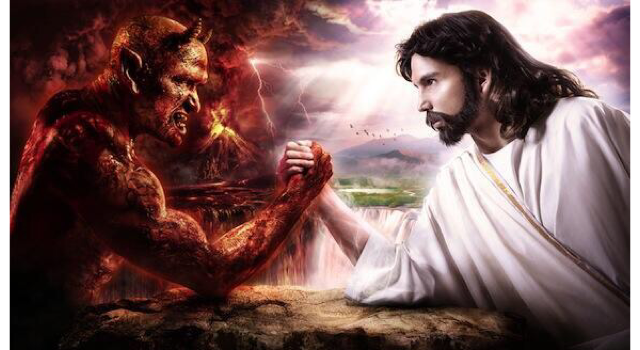
God, The Devil, A Critical Look At Justice, Power, And Responsibility.
The God worshipped in Judaism, Christianity, and Islam is described as all-powerful, all-knowing, and perfectly just.
Yet within the Bible and the Qur’an are repeated accounts of destruction, punishment, and suffering attributed directly to God.
If God created everything, why does He respond to human failure with suffering and judgement?
Why would a perfect Creator allow or create a system involving suffering at all?
And alongside this:
Why is the Devil feared so deeply, when his role appears far more limited?
Across these scriptures, God is not only a creator, but also an active judge, one who brings consequences on a large scale.
The Flood, A World Erased.
“I will wipe from the face of the earth the human race I have created.”
( Genesis 6:7 )
“We drowned them all.”
( Qur’an 7:136 )
The explanation given is human corruption.
The flood is described as a reset, an act of judgement against widespread evil.
But this raises a stark question:
Why create a world capable of such failure, only to destroy it?
Sodom And Gomorrah, Fire From Heaven.
“The Lord rained down burning sulphur… from the Lord out of the heavens.”
( Genesis 19:24 )
“We rained upon them a rain of stones.”
( Qur’an 7:84 )
The cities are described as deeply immoral.
Yet the response is total destruction.
Why is there no path of reform, only annihilation?
Egypt, The Punishment On A Nation.
“Every first-born son in Egypt will die.”
( Exodus 11:5 )
“We sent upon them the flood, locusts, lice, frogs, and blood.”
( Qur’an 7:133 )
The stated aim is to force a ruler, Pharaoh, to release slaves.
But the suffering falls on an entire population.
Why are ordinary people, including children, made to pay the price?
Commands Of Destruction.
“Do not leave alive anything that breathes.”
( Deuteronomy 20:16 )
Here, destruction is not only permitted, but commanded.
Can such instructions be reconciled with the idea of a loving Creator?
Creator Of Both Good And Harm.
“I form the light and create darkness, I bring prosperity and create disaster.”
( Isaiah 45:7 )
This passage makes something explicit:
God is not only associated with good, but also with calamity.
If both are created by the same source, where does responsibility lie?
The Devil, A Different Kind Of Power.
Alongside God stands another figure: the Devil.
But his identity is less straightforward than many assume.
Satan: from Hebrew, meaning adversary or accuser.
Lucifer: meaning light-bringer, later linked to a fallen being.
Iblis: in Islam, a being who refuses God’s command.
In Judaism, this figure can appear more as a role than an enemy.
In Christianity, he is often seen as a fallen angel.
In Islam, he is a rebellious being created by God.
“I am better than him. You created me from fire and him from clay.”
( Qur’an 7:12 )
What Harm Does the Devil Actually Do?
Unlike God, the Devil’s power is usually indirect.
Temptation, Not Force.
“The serpent said… ‘You will not certainly die.’”
( Genesis 3:4 )
“Satan made their deeds seem fair to them.”
( Qur’an 8:48 )
He persuades, misleads, and influences, but does not compel.
The Story of Job.
“He struck Job with painful sores…”
( Job 2:7 )
But only after permission is granted:
“Everything he has is in your power… but do not harm him.”
( Job 1:12 )
Even here, the Devil operates within boundaries set by God.
A Destroyer, Or A Deceiver?
“He was a murderer from the beginning… a liar and the father of lies.”
( John 8:44 )
The emphasis is on deception.
Not mass destruction, but moral corruption.
A Difficult Comparison.
Looking at these texts side by side:
- God brings floods, plagues, destruction, death and disaster.
- The Devil tempts, deceives, and misleads.
“The thief comes only to steal and kill and destroy.”
( John 10:10 )
And yet, large-scale suffering is more often attributed directly to God.
This leads to an uncomfortable question:
Why is the Devil feared as the ultimate enemy, when his visible power appears far more limited?
Ancient quotes describe the Devil as a deceiver, accuser, and tempter, often portraying him as a ‘prowling enemy’ or a ‘roaring lion’ looking to destroy the faithful.
“Be alert and of sober mind. Your enemy the devil prowls around like a roaring lion looking for someone to devour”.
( 1 Peter 5:8 )
“Satan frightens you with poverty and bids you to commit indecency”.
( Qur’an 2:268 )
Conclusion.
These scriptures present a striking contrast:
- A Creator who gives life, but also takes it on a vast scale.
- An adversary who corrupts, but operates within limits.
This raises deeper questions:
- Why create a system where suffering is necessary at all?
- Why is destruction framed as justice?
- And why is the lesser power feared more than the greater one?
These are not new questions.
They have been asked, debated, and wrestled with for centuries.
And they remain, for many, unresolved.
“The devil has fear only, but fear has no strength.
Don’t fear him, then, and he will flee from you”.
( The Shepherd of Hermas, c. AD 160 )
Related Posts

Comments (0)