An Israeli Company Is Developing Milk Using Animal Cells. Wilk Technologies, formerly BioMilk, is an…
Humans Are Not Natural Carnivores.
Although we think we are, and we act as if we are, human beings are not natural carnivores.
When we kill animals to eat them, they end up killing us, because their flesh, which contains cholesterol and saturated fat, was never intended for human beings, who are natural herbivores.
( Dr William C. Roberts )
All fresh meat is eaten in a state of decay.
The process may not have proceeded so far that the dull human nose can discover it, but a carrion bird or a carrion fly can smell it from afar.
( John Harvey Kellogg )
It’s The Way Things Are.
We send one species to the butcher and give our love and kindness to another apparently for no reason other than because “it’s the way things are”.
When our attitudes and behaviours towards animals are so inconsistent, and this inconsistency is so unexamined, we can safely say we have been fed absurdities.
It is absurd that we eat pigs and love dogs and don’t even know why.
Many of us spend long minutes in the aisle of the drugstore mulling over what toothpaste to buy, yet most of us don’t spend any time at all thinking about what species of animal we eat and why.
Our choices as consumers drive an industry that kills ten billion animals per year in the United States alone.
If we choose to support this industry and the best reason we can come up with is because it’s the way things are, clearly something is amiss.
( Melanie Joy )
The only foods that contain immune-strengthening and cancer-fighting nutrients are plant foods.
( Mike Anderson )
A Serious Public Health And Environmental Justice Issue.
Animal agriculture is an extremely cruel, inefficient, and resource-intensive way to produce food for the growing human population.
It pollutes our environment while consuming huge quantities of water, grain, petroleum, and pesticides.
It also subjects animals to extreme confinement, mutilations without painkillers, and ruthless slaughter.
But industrial animal farms aren’t just awful for animals and the planet; they’re also a serious public health and environmental justice issue for nearby communities.
People living near factory farms have complained that farmers spray faeces and urine into the air to “dispose of” the waste.
The Natural Resources Defence Council states: People who live near or work at factory farms breathe in hundreds of gases, which are formed as manure decomposes.
For instance, one gas released by the lagoons, hydrogen sulfide, is dangerous even at low levels.
Its effects, which are irreversible, range from sore throat to seizures, comas and even death.
More often than not, these facilities are built near low-income communities and communities of colour.
While the grave consequences of factory farming are vast, we all have the power to create a better world every time we sit down to eat.
By choosing delicious vegan foods, we can stand up for vulnerable communities who suffer discrimination, spare countless animals a lifetime of misery, and stop wasting resources.
( Sarah Von Alt, 27.02.2017 )
Scientists have been warning of the health risks of eating red and processed meat for some years with evidence pointing to them containing chemicals that can cause cancer.
( Ruki Sayid, 24.10.2015 )
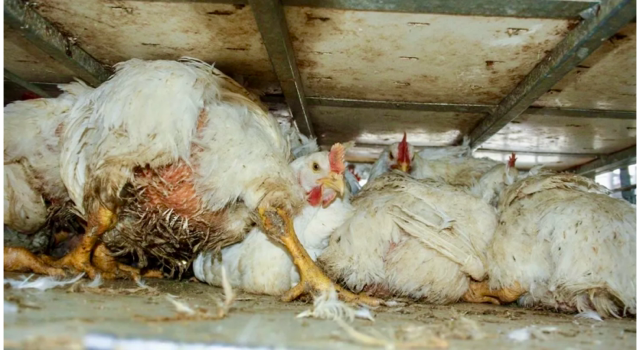
Drug-Stuffed, Disease-Ridden, Shit-Contaminated Chicken.
Scientific studies and government records suggest that virtually all (upwards of 95% of) chickens become infected with E. coli (an indicator of fecal contamination) and between 39 and 75% of chickens in retail stores are still infected.
Around 8% of birds become infected with salmonella (down from several years ago, when at least one in four birds was infected, which still occurs on some farms).
Seventy to 90% are infected with another potentially deadly pathogen, campylobacter.
Chlorine baths are commonly used to remove slime, odour, and bacteria.
Of course, consumers might notice that their chickens don’t taste quite right, how good could a drug-stuffed, disease-ridden, shit-contaminated animal possibly taste?
But the birds will be injected (or otherwise pumped up) with “broths” and salty solutions to give them what we have come to think of as the chicken look, smell, and taste.
A recent study by Consumer Reports found that chicken and turkey products, many labeled as natural, “ballooned with 10 to 30% of their weight as broth, flavouring, or water.”
( Jonathan Safran Foer )
Meat is pieces of rotting bodies.
Meat is pieces of the unburied dead.
Think seriously before you put decaying flesh in your mouth.
( Rose Winfold )
Our Evolution And Physiology Are Herbivorous.
Like the intestines of other herbivores, human intestines are very long.
Carnivores have short intestines so they can quickly get rid of all that rotting flesh they eat.
Human hands are perfect for grabbing and picking fruits and vegetables.
Most humans are “behavioural omnivores”, that is, we eat meat, so that defines us as omnivorous.
But our evolution and physiology are herbivorous, and ample science proves that when we choose to eat meat, that causes problems, from decreased energy and a need for more sleep up to increased risk for obesity, diabetes, heart disease and cancer.
( Wilfred Soon )
Hamburger steak is carrion, and quite unfit for food except by a turkey buzzard, a hyena, or some other scavenger.
( John Harvey Kellogg )
Humans Are Not Designed To Eat Meat.
Humans aren’t physiologically designed to eat meat.
I think the evidence is pretty clear.
If you look at various characteristics of carnivores versus herbivores, it doesn’t take a genius to see where humans line up.
A herbivore’s intestines are 12 times its body length, and humans are closer to herbivores.
Both get vitamin C from their diets (carnivores make it internally).
Both sip water, not lap it up with their tongues.
Both cool their bodies by perspiring (carnivores pant).
( William C. Roberts, Cardiologist )
Palm oil, used in crisps and chocolate, was found to cause the cancer protein CD36 to spread, says a study in the journal Nature.
( Metro, 08.12.2016 )
Medical Staff Leaving The NHS.
The number of stressed workers quitting the NHS has more than doubled in just four years.
New figures show nearly 14,000 staff left last year because they wanted a better work-life balance.
In 2011/2012 the figure was 6,727.
The number who left for health reasons also soared, from 2,138 four years ago to 3,068 last year.
Unions say the NHS is spending millions on agency staff to plug gaps and claim patients will be at risk from dangerous staff levels.
Figures from the Health and Social Care Information Centre shows nearly 67,000 clinical staff, including 15,656 doctors and 31,546 nurses, left the NHS last year.
( Nicola Fifield, 12.06.2016 )
Related Posts

Comments (0)