NHS Contracts Given To Private Firms Owned By People Living In Tax Havens. Private firms…
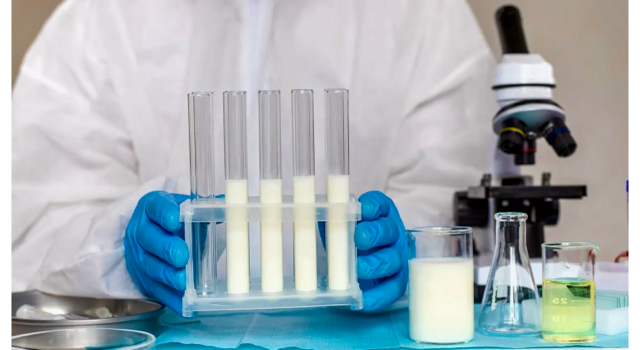
An Israeli Company Is Developing Milk Using Animal Cells.
Wilk Technologies, formerly BioMilk, is an Israeli biotechnology company developing cell-cultured human and animal milk.
Its technology uses mammary cells grown outside the animal and attempts to get those cells to produce milk components.
Wilk has patents covering in-vitro milk production.
Cells can be taken from mammary tissue and grown in the laboratory.
Wilk’s researchers have described taking cow mammary cells either from milk or tissue biopsies and growing them in the laboratory.
For human milk research, they have obtained cells from donated breast milk and from breast tissue removed during breast-reduction surgery.
The cells are grown in bioreactors and stimulated to produce milk components.
This is genuine technology.
Wilk’s patent describes mammary cells being supplied with nutrients and different culture media, including lactation medium, growth-factor medium, oestrogen/progesterone and other substances, with the cells subsequently secreting milk that can be collected.
Wilk Technologies has received investment from Danone.
This isn’t a conspiracy or internet rumour.
In 2023, Danone’s venture arm invested $2 million in Wilk, as part of a $3.5 million funding round.
The stated interest included developing cultured breast-milk components for infant formula.
And there’s another interesting detail: Central Bottling Co., which owns Coca-Cola Israel, also participated in the investment round.
What Is “Lab-Grown Milk”?
There are several different technologies that can loosely be described as “lab-grown milk”.
One approach is precision fermentation.
Micro-organisms are genetically modified so that they produce particular milk proteins, such as whey proteins.
The micro-organisms are then removed and the resulting proteins can be used as ingredients.
A rather different approach is cell-cultured milk.
Here, scientists work with mammary cells, the cells that naturally make milk inside a mammary gland.
The aim is to grow those cells outside the animal and persuade them to continue performing their natural function.
One company working in this area is the Israeli biotechnology company Wilk Technologies.
Wilk’s patents describe systems involving mammary epithelial cells, specialised culture conditions and methods for collecting the substances secreted by those cells.
One of Wilk’s patents, for example, describes experiments using primary bovine mammary epithelial cells obtained from lactating Holstein cows.
The researchers then exposed the cells to various substances and measured milk-related components including fat, protein and lactose.
So the basic science is not imaginary.
Scientists really are trying to make mammary cells behave like tiny milk-producing factories.
Precision-Fermented Milk.
Companies such as Perfect Day use genetically modified microorganisms, rather than mammary cells, to manufacture individual milk proteins such as whey.
The microorganism makes the protein, and then the microorganism is removed.
This technology is already considerably further along commercially.
The FDA has given a “no questions” response to Perfect Day’s β-lactoglobulin, for example.
The UK’s Food Standards Agency describes precision-fermented dairy in essentially these terms: genetically modified microorganisms produce milk proteins such as whey and casein, which can then be incorporated into food.
Cell-Cultured Milk.
This is what Wilk Technologies is attempting.
Instead of microorganisms making an individual protein, you grow mammary cells and try to get them to produce a much more complete milk composition.
This is considerably more experimental.
Indeed, Danone itself has acknowledged the distinction, describing precision fermentation as an established technology while saying that cell-based culture is still very much in its infancy and at laboratory scale.
Scientists really are trying to take the cells whose natural job is to make milk, put them in a controlled environment, feed them the appropriate nutrients and signalling molecules, and persuade them to continue doing what they do inside a mammary gland, producing milk.
Wilk Technologies even reports having produced specific human breast-milk components, including lactoferrin, and has reported laboratory production of milk fat.
Whether they can eventually produce large quantities of nutritionally complete milk economically, safely and consistently is another matter entirely.
Lab-Grown Milk, Mammary Cells and the Curious Case of SV40.
There is a fascinating new area of biotechnology attempting to produce milk without obtaining it from a living, lactating animal.
The idea sounds like science fiction: take mammary cells, grow them in a laboratory, provide the right nutrients and biological signals, and persuade those cells to produce milk or individual milk components.
But this technology is real.
There is also a rather surprising story involving a virus called SV40, and this is where things become more complicated.
Some of the claims circulating about SV40 and cultured milk are genuine.
Others appear to be based on patents and laboratory research but have been attached to the wrong company.
And some claims remain completely unsubstantiated.
What Exactly Is SV40?
SV40 stands for Simian Virus 40.
It is a virus originally associated with monkeys and became particularly famous because it was accidentally present in some polio vaccines produced between 1955 and 1963.
The virus came from monkey kidney cells that were used to grow the poliovirus.
The CDC estimates that around 10–30% of polio vaccines administered in the United States during that period were contaminated with SV40.
Once this was discovered, testing requirements were introduced to ensure that new polio vaccine lots were free of the virus.
SV40 subsequently became an important laboratory research tool.
One reason is that SV40 can interfere with normal cellular growth mechanisms and can be used experimentally to produce cells that continue growing in culture.
What Does “Immortalised” Mean?
This is where some of the terminology can sound much more frightening than it really is.
Normally, cells grown in a laboratory eventually stop dividing.
Scientists can sometimes alter cells so that they continue dividing for a very long time.
Such cells are described as “immortalised”.
In this context, “immortal” doesn’t mean that the cells are indestructible or somehow alive forever.
It means that they have acquired the ability to keep reproducing beyond the normal lifespan of the original cells.
There are several ways researchers can achieve this.
One method involves hTERT, a component associated with the maintenance of telomeres.
Another method, historically used in laboratory research, involves SV40.
SV40 Really Has Been Used On Human Breast Cells.
This is not an internet rumour.
In 1982, researchers published a study entitled: “Establishment and characterization of SV40-transformed human breast epithelial cell lines.”
The researchers took human breast epithelial cells cultured from milk and transformed them using SV40.
The resulting cells contained SV40 large T-antigen.
A later study described creating an immortal human mammary epithelial cell line by introducing SV40 DNA into individual cells from cultures of human milk epithelial cells.
Therefore, this statement is entirely legitimate: “SV40 has been used in laboratory research to immortalise human mammary/breast cells.”
But that fact by itself does not tell us whether anybody is using the technique to make milk intended for people to drink.
The Surprising Patent.
There is, however, a patent that makes the connection between SV40, mammary cells and cultured milk considerably more interesting.
U.S. patent application US20210403865A1, titled: “Live cell constructs for production of cultured milk product and methods using the same” was filed by BIOMILQ, Inc.
The patent describes producing cultured milk from mammary cells.
And it explicitly discusses immortalised mammary cells containing genetic material encoding either human telomerase reverse transcriptase (hTERT) or SV40.
It also describes mammary cells being obtained from sources including breast tissue, udder tissue, teat tissue and raw breast milk.
That is a genuine and rather remarkable document.
It means that the following general concept has genuinely appeared in a cultured-milk patent: mammary cells → immortalisation → SV40 or another method → milk production.
The patent even describes cultured milk intended for nutritional use.
The patent belongs to BIOMILQ, not Wilk Technologies.
Wilk and BIOMILQ are separate companies.
Wilk has its own patents and its own research programme.
When you look at Wilk’s published patent describing its experimental work, the picture is different.
Wilk’s 2023 patent application describes experiments using primary bovine mammary epithelial cells obtained from three lactating Holstein cows.
The experimental work describes stimulating those cells with substances including hormones, fatty acids and amino acids and then measuring milk-related products.
There is no evidence in that experimental description that SV40 was used.
What About The Claim That SV40 Causes Cancer?
This is another area where the truth is more complicated than either extreme.
SV40 has properties that can transform cells in laboratory experiments, and it has been associated with tumour formation in some experimental animal studies.
That is why scientists have taken it seriously.
But the question of whether exposure to SV40 has caused cancer in humans is much more difficult.
The CDC notes that most studies examining the relationship between SV40-contaminated polio vaccines and cancer have been reassuring and have not found a causal association between receiving those vaccines and developing cancer.
The existence of the BIOMILQ patent means that the SV40/mammary-cell/cultured-milk connection is not fabricated.
Does That Mean SV40 Is Being Used In Food Production?
This is where we have to be very careful.
SV40 has definitely been used in laboratory research involving cells relevant to food and milk production.
There is also a patent describing SV40 as one possible method of immortalising mammary cells for cultured-milk production.
But that is not the same as demonstrating that: SV40 is currently being used to manufacture a commercial milk product.
Nor does it demonstrate that SV40 is present in a finished food product.
Those would require additional evidence.
Would The Finished Milk Actually Contain SV40?
This is another important question.
If SV40 were used as a tool to alter or immortalise a mammary cell line, the virus or its genetic material would primarily be associated with the cells themselves.
The cells are the production machinery.
The milk is the material secreted by the cells.
The distinction is somewhat analogous to using yeast to manufacture beer: the organism performs the manufacturing process, but the finished product is not simply the organism itself.
That does not automatically answer every food-safety question.
If an immortalised cell line were ever used commercially, regulators would need to consider the characteristics of the cells, the production process, potential contaminants, residual materials and the composition and safety of the final product.
But it would be incorrect to assume that because SV40 was used somewhere in the history of a cell line, the finished milk must necessarily contain infectious SV40 virus.
That would need to be demonstrated experimentally.
The Technology Is Still At An Early Stage.
The existence of cultured milk doesn’t mean that scientists have decided plant milk isn’t nutritious enough.
Plant-based milk already provides perfectly viable alternatives for many people.
The scientific ambition behind cultured milk is different: to reproduce some of the biological complexity and functional properties of animal milk while eliminating the need for the animal.
Whether that is worth the enormous cost and technological complexity is a perfectly legitimate question.
If soy, oat or pea milk can provide adequate nutrition with substantially less environmental impact and at much lower technological complexity, why spend billions trying to recreate cow’s milk molecule-for-molecule?
There isn’t a definitive answer to that yet.
This is not a brand-new technology invented in the last couple of years.
The underlying cellular research goes back decades, some of the specific mammary-milk research goes back around a decade or more, and the current commercial companies and patent programmes emerged mainly around 2020–2022.
The attraction is that cultured milk could potentially offer something plant milk cannot easily provide: the actual proteins, fats, sugars and other molecules characteristic of animal or human milk, produced without maintaining the animal.
Whether that technological achievement is worth the money, energy and complexity remains very much open to debate.
We are not talking about a mature industry secretly replacing ordinary milk on supermarket shelves.
The research and patent activity is real, substantial and several years old, but the commercial end point is still uncertain.
Although reports in 2021 sometimes gave the impression that lab-grown cow’s milk was already reaching consumers, the reality was rather different.
Israeli company BioMilk (later renamed Wilk) had succeeded in producing milk from mammary cells in laboratory conditions, but the technology was still at the development stage.
In July 2021, the company announced a $2million investment from Israel’s Central Bottling Company and plans to transfer its products to Tara Dairy for pilot commercial production.
The stated objective was to accelerate the technology’s eventual arrival on supermarket shelves, indicating that it was not already a commercially available supermarket product.
Related Posts


Rất đáng đọc, cảm ơn tác giả. Công ty Letco cung cấp dịch vụ du học Hàn Quốc trọn gói, tư vấn tận tâm và minh bạch chi phí. Tìm hiểu tại letco.vn.